

Do You Have to Pay Your Real Estate Agent in Kansas City?
Do You Have to Pay Your Real Estate Agent in Kansas City?
What Buyers Need to Know in 2026
Short answer: usually not out of your own pocket, but it depends on how your offer is written, and you need to understand this before you sign anything. If you've started looking at homes in the Kansas City metro this year, you've probably already run into a real estate agent asking you to sign something before they'll show you a house. That single piece of paper has caused more confusion among buyers than almost anything else in this market, and I want to walk you through exactly what it means, in plain language, with no sales pitch attached.
What Actually Changed
In August 2024, the National Association of Realtors settled a major lawsuit over how real estate commissions were handled. The old system worked like this: a seller agreed to pay a total commission, and the listing agent split part of that fee with whichever agent brought the buyer. That split was advertised right on the MLS, which meant buyers rarely thought about it at all. It was baked into the deal before they ever showed up.
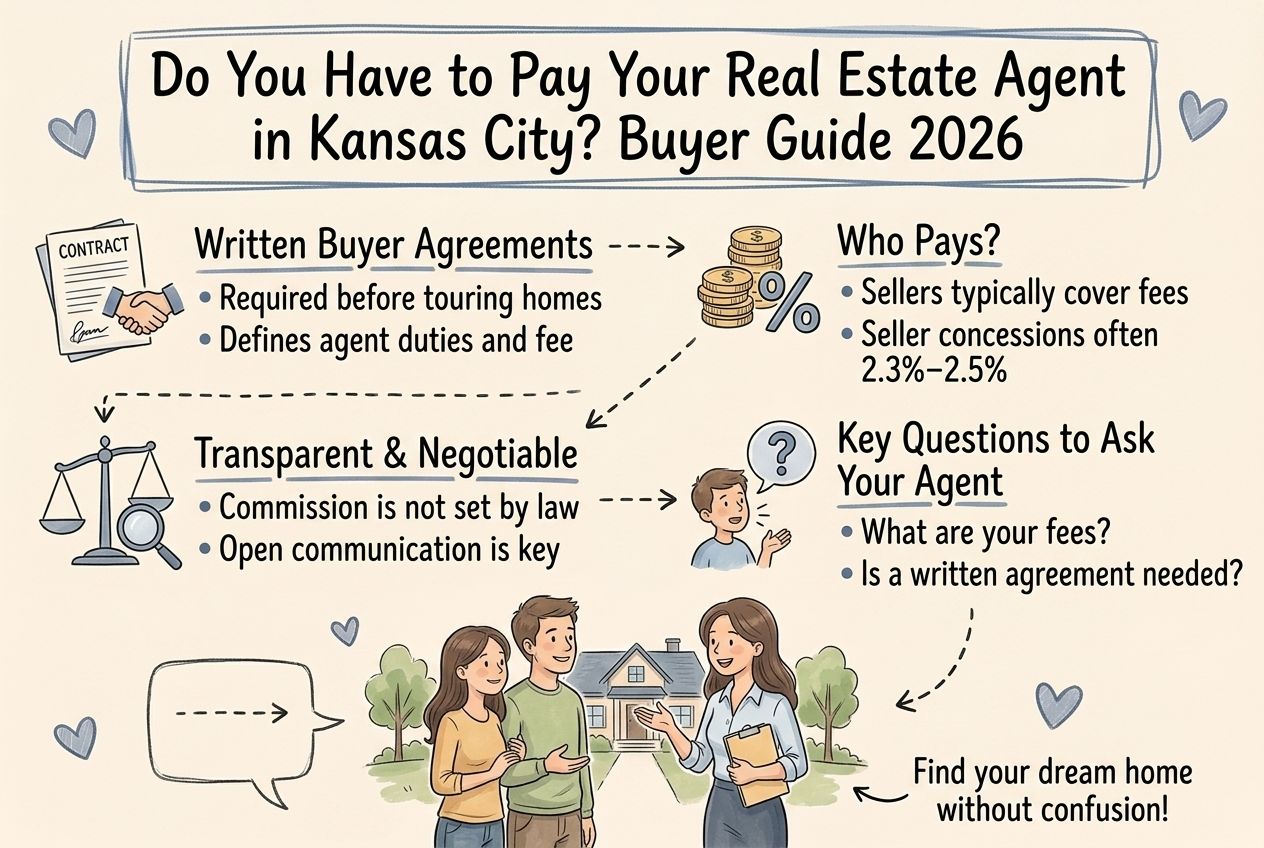
That's no longer how it works. Sellers can no longer advertise a buyer's agent fee on the MLS, and buyers are now required to sign a written agreement with their agent before touring homes together. That agreement has to spell out what the agent will do for you and how they'll be paid. As of January 2026, the update to the REALTOR Code of Ethics reinforced these same practices, so this isn't a temporary adjustment period. This is simply how buyer representation works now.
Here's the part that trips people up: signing that agreement does not automatically mean you're paying out of pocket. It means the compensation conversation now happens explicitly and in writing, instead of being invisible.
So Who Actually Pays?
In most Kansas City transactions right now, the seller still ends up covering some or all of the buyer's agent fee. They just do it through a negotiated concession written into the purchase offer, rather than a number pre-advertised on the listing. Nationally, roughly three-quarters or more of sellers continue to offer some form of buyer-agent compensation, and that pattern holds true locally, especially in a market where sellers are motivated to keep their pool of buyers as wide as possible.
Current Kansas City-area data puts the total average commission around 5.7% to 5.9% of the sale price, typically split between the listing side and the buyer's side. Locally, listing agent fees tend to run about 2.5% to 3%, with buyer's agent compensation landing somewhere between roughly 2.3% and 2.5% when a seller agrees to cover it. Those numbers move deal to deal, but they give you a realistic range to expect rather than a guess.
The honest version of the math looks like this: if your agreement states your agent's fee at 2.5% and the seller agrees to pay it in full through the offer, you owe nothing directly. If the seller only agrees to cover part of it, you're responsible for the difference, and you want to know that number before you write an offer, not after it's accepted. This is exactly why the written agreement exists. It forces that conversation to happen up front instead of surprising you at the closing table.
What Should Actually Be In Your Buyer Agreement
A buyer agreement isn't something to be afraid of, but it is something worth reading carefully, line by line, before you sign it. A fair agreement should clearly state your agent's fee or fee structure, whether that fee changes if the seller offers a concession, how long the agreement lasts, and how you can exit it if the relationship isn't working. A reasonable term is measured in weeks, not months. Be cautious of anything that locks you in for six months to a year with no simple way out.
It's also fair to ask your agent direct questions before you sign anything: What happens if the seller won't cover your full fee? Are there any additional fees beyond the stated commission? What exactly are you agreeing to receive in return? A good agent will walk through all of this with you without rushing you, and will not treat the agreement as a formality to get out of the way.
Is a Buyer's Agent Even Worth It Now?
This is a fair question, especially with so many listings visible on Zillow and Realtor.com. Here's the honest answer: a portal shows you what's public. It doesn't show you what's about to hit the market, doesn't pull real comparable sales the way MLS access does, and it definitely doesn't negotiate on your behalf. A buyer's agent's job is pricing strategy before you write an offer, structuring the terms so your offer stands out beyond just the number, walking you through inspection findings without a conflict of interest, and catching the details in a purchase contract that aren't obvious to someone doing this for the first time. In a market that has genuinely shifted in buyers' favor, that negotiating experience is worth more than it was two years ago, not less.
Why This Matters Even More in Today's Kansas City Market
The commission conversation is happening at the same time the Kansas City market itself is shifting. Mortgage rates have been sitting in the mid-6% range through much of 2026, inventory across the metro has improved compared to the tight conditions of recent years, and homes are generally sitting on the market longer than they were during the frantic pace of 2021 through 2023. That combination gives buyers more room to negotiate than they've had in a while, on price, on closing costs, and yes, on who covers agent compensation.
That doesn't mean every home is sitting unsold. Well-priced properties in strong school districts and popular Northland communities like Liberty, Parkville, and Gladstone can still draw quick, competitive interest. But the overall tone of the market has moved from urgency to strategy. Buyers who understand both the financing side and the representation side of a purchase are the ones positioned to take advantage of that shift.
A Few Straight Answers to Common Questions
Do I have to sign a buyer agreement to just look at a home? No. If you're attending an open house on your own or simply asking an agent general questions, you don't need to sign anything. The agreement is required before an agent tours homes with you directly.
Can I negotiate the fee in my buyer agreement? Yes. Compensation is fully negotiable and should be discussed openly before you sign, not treated as a fixed number.
What if I want to work with a different agent later? Review the exit terms before you sign. A reasonable agreement includes a straightforward way to end the relationship if it isn't working.
Will I owe money if the seller won't cover my agent's fee? Possibly, depending on how your agreement and offer are written. This is exactly why reviewing the numbers before you submit an offer matters so much.
The Bottom Line
The rules around how buyer's agents get paid changed, but the goal behind those changes was more transparency, not more cost. Most Kansas City buyers still aren't paying out of pocket in the end, but the only way to know for certain is to have the conversation early, read the agreement carefully, and work with someone who explains it instead of rushing past it.
If you've already been handed a buyer agreement and aren't sure what you're looking at, or if you're just starting to think about buying somewhere in the Kansas City metro or the Northland suburbs, I'm happy to walk through it with you. No pressure, no obligation, just a straight answer.
Matthew Graham is a Broker Associate with Epique Realty, serving buyers and sellers across Kansas City and the Northland suburbs, with 28 years of experience and more than 3,000 closings.
Categories
Recent Posts

Market Preparation Tips: Get Your Home Sale-Ready Fast

Quick Cash Sale: Everything You Need to Know About Selling Your House for Cash

Downsizing Strategies: The Complete Guide to Moving to a Smaller Home
Navigating the Probate Real Estate Process: A Complete Guide for Executors and Heirs
Real Estate Investment Guide: Building Wealth Through Kansas City Property

Home Staging Secrets That Sell Homes Faster and For More Money

Kansas City Real Estate Market Trends 2026: What Buyers and Sellers Need to Know
10 Essential Tips for First-Time Home Buyers in 2026

Your Guide to Kansas City's Best Neighborhoods: Where to Live
GET MORE INFORMATION